
Benefits. TO TRUST OR NOT TO TRUST
If your Estate exceeds or is about to exceed R3 500 000, including the death value of your Life Assurance, or you have any form of assets you wish to protect from Creditors you need to have your assets owned by a Trust.
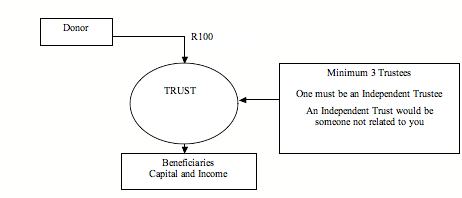
A Trust is formed when the Donor (Another name for the Donor is the Founder or Settler of the Trust) together with the Trustees decides to form a Trust for the Benefit of the Beneficiaries.
A Trust looks as follows:
The Benefits of a Trust
1. To Distance yourself from your assets
The reason is to protect your Assets over time from Creditors and to legally minimize various taxes. I.E. Estate Duty.
2. The Freezing of your Estate
Your Personal Estate is frozen on your Death and it will take on average 2 years to wind up your Estate
The Assets in a Trust are NOT frozen on your death and the beneficiaries of the Trust have almost immediate access to them. All that is required is for a new Trustee to be appointed to replace the Deceased Trustee which take approximately 3 weeks.
3. Executors Fees
Your Personal Estate will pay 3.5% plus VAT on the Gross value of your Estate in Executors Fees. This amounts to a total of 3.99%
No Executors Fees are paid on the Assets belonging to a Trust.
4. Taxes
Whenever you make a financial decision you need to take into account the following 5 major Taxes. You then need to have a look at how each Tax will affect your Investment and then armed with this knowledge you can make an informed decision on how to own the Investment. I.E. in your Personal Name or in a Trust
Income Tax
Personally you will pay an average rate of Tax of 29% on an Income of R580 000 and 40% Tax on any income in excess of R580 000.
A Trust will pay Tax at a Flat Rate of 40% from the first Rand of Income.
Thus on the surface it looks as if a Trust pays more Tax than a Natural Person. However because of the “Conduit Pipe” principle of a Trust the income earned by the Trust can be passed out to the Beneficiaries who will then pay Tax in their Personal capacity.
Therefore if the income was under R580 000 the Trustees could pass the income to the Beneficiaries who will pay Tax at the lower Tax rate. However the moment the Beneficiaries income exceeds R580 000 it makes no difference who pays the Tax as the Tax rate for both the Natural Person and the Trust is 40%. You have more choices in a Trust.(Any income passed out to minor beneficiaries will be deemed to be the income of the parent. You can only split income amongst major Beneficiaries.)
Donations Tax
Personally you will pay Donations tax at a Rate of 20% on any Donations in excess of R100 000 (A married couple R200 000)
In terms of Sections 56 (1) (k) of the Income Tax Act a Trust is specifically exempt from paying Donations Tax when it distributes any Income or Capital to a Beneficiary.
Thus if you were married and you gave R1 200 000 to a child to buy a Property you would attract Donations Tax as follows. R1 200 000 less R200 000 (exempt amount) = R1 000 000 X 20% Donations Tax = R200 000 Donation Tax Payable. Your child is thus left with only R1 000 000. Please note that the person who make the Donation is responsible to pay Tax.
If the Child was a Capital and Income beneficiary of the Trust No Donations Tax would become payable as Trusts are exempt from paying Donations Tax and your child would receive R1 200 000 and not R1 000 000 a saving of R200 000 in Tax.
Transfer Duty on Property
When you purchase Property you can either buy a New Development or an Existing Property
With a New Development one normally pays VAT which is built into the purchase price thus no Transfer Duty is payable by either you Personally or the Trust. The Tax is identical.
If it is an existing Property Transfer Duty is identical whether you purchase the property in your own Personal Name or a Trust and is payable as follows:
| First R600 000 | = | No Transfer Duty payable |
| Next R400 000 | = | 3% or R12 000 |
| Next R500 000 | = | 5% or R25 000 |
| Over R1 500 000 | = | 8% |
Estate Duty
Your Estate will pay Estate Duty at a rate of 20% on the net value of your Estate in excess of R3 500 000. The only exception is if you bequeath your Estate to your spouse under Section 4Q of the Estate Duty Act. This doesn’t mean that Estate Duty will not be paid, it is just deferred to the Death of the surviving Spouse.
No Estate Duty is payable on the Assets held in the Trust other than on Life Assurance.
Therefore if your Estate is worth R20 000 0000 you would pay Estate Duty as follows:
R20 000 000 - R3 500 000 = R16 500 000 X 20% =R3 300 000 Estate Duty Payable.
If the R20 000 000 worth of Assets were owned by a Trust no Estate Duty become payable and you save R3 300 000. This is a huge benefit as far as Trusts are concerned added to the fact that Estate Duty is paid every Generation if assets where held in your personal name whereas in a Trust no Estate Duty is payable from one generation to the next.
As of the 2010 Tax year if you bequeath your entire estate to your spouse they will not lose your R3 500 000 concession thus on the death of the second spouse they will be able to claim R7 000 000 as an abatement. Thus if the Estate was worth R20 000 000 Estate Duty would only be paid on R13 000 000 or R2 600 000 as apposed to paying Estate Duty on R16 500 000 or R3 300 000
You are also able via a Trust to increase the Estate Duty Limit to R7 000 000 whilst still giving control of your assets to your spouse on your death and thus save R700 000 in Estate Duty.
Capital Gains Tax
Personally you will pay Capital Gains Tax at a Rate of 25% of the Gain of the Investment multiplied by your marginal Rate of Tax i.e 40%. Please note that in order to work out your Tax Rate you add the Capital Gain onto your Income. Thus if you did not earn an income but made a R580 001 gain on an Investment your Marginal Rate of Tax would be 40%, the Marginal Rate of Tax on an income of R580 001 and you would pay Capital Gains Tax on the profit or gain you made as follows: Capital Gain x 25% x 40% = 10% Capital Gains Tax
Death however is also considered to be a Capital Gains Tax event thus on your Death your Estate will pay Capital Gains Tax plus Estate Duty and Executors Fees. This amounts to approximately 31% of the future growth of your Estate.
A Trust will pay Capital Gains Tax at one on three rates:
- 20% if the Trust sells the Assets and keeps the gain in the Trust.
- 10% if it passes the gain out to a beneficiary. This is equal to the Tax rate of a Natural Person thus you will never pay more Capital Gains Tax in a Trust than in your own Personal Name.
- 0% if the Trust does not sell the Assets at the time of your Death.
Thus if you purchase R1 000 000 worth of shares and you die when the shares are valued at R6 000 000 you would have made a R5 000 000 Capital Gain.
Your Personal Estate will pay R500 000 in CGT (10%) compared to the following in a Trust. (I have excluded the Rebate of R20 000)
- R1 000 000 (20%) if the Trustees decide to sell the Shares and keep the Capital Gain in the Trust.
- R500 000 (10%) if the Trustees decide to sell the shares and pass the Capital Gain out of the Trust to the beneficiaries.
- R0 if the Trustees decide not to sell the shares on your death. This does not mean that Capital Gains Tax will never be paid however Capital
Gains Tax will only be paid when the shares are sold. You are not forced to come up with R500 000 to R1 000 000 which might necessitate the selling of the shares you did not want to sell.
Death Bed Expenses
Besides your normal Liabilities on Death I.E. Bonds, Overdrafts and Medical Expenses one also has to take into account Estate Duty, Capital Gains Tax and Executors Fees which amounts to approximately 31% of the Future Growth of your Estate if the assets were held in your Personal Name.
If the assets were held in a Trust no Estate Duty or Executors Feel are payable however you would have to pay Capital Gains Tax at one of three Tax rates 20%, 10% or 0%. However if compared to 31% tax in your personal name this is a substantial savings.
As you can see when looking objectively at owning Assets in your own name compared to a Trust a Trust wins hands down every time and is therefore the recommended vehicle for planning your Estate.